






Did you know that a mid-range Intel Core Ultra 5 250K Plus is now a staggering 85.9% faster than its direct rivals in multi-threaded tasks? Choosing between modern processors has never been more exciting; or more confusing. You probably feel overwhelmed by the constant debate over cores versus clock speeds. It's a common worry; the last thing you want is to buy a cutting-edge chip only to realise it's incompatible with your socket type.
We understand that finding the right balance for a gaming rig or a professional workstation is tough. That's why we've built this expert Irish buying guide to help you master the technical jargon. We promise to show you exactly which hardware delivers the best value for your specific needs. We'll compare the gaming dominance of AMD's Ryzen 9 9950X3D against the incredible multi-core value of Intel's Arrow Lake Refresh series. Let's get your PC build sorted with total confidence and the unbeatable performance you deserve.
Key Takeaways
- Master technical jargon to understand how your CPU dictates the speed of every command and 4K video render.
- Decode the difference between physical cores and virtual threads to ensure your system handles heavy workloads without breaking a sweat.
- Compare the 2026 line-up of AMD and Intel processors to find the perfect match for your motherboard and future-proofing needs.
- Pinpoint the "sweet spot" chips that deliver maximum performance for gaming, work, or creative projects without overspending.
- Leverage local Irish expertise and custom assembly services to get your dream PC up and running with zero stress.
The Brain of Your Build: Why the Right Processor Matters
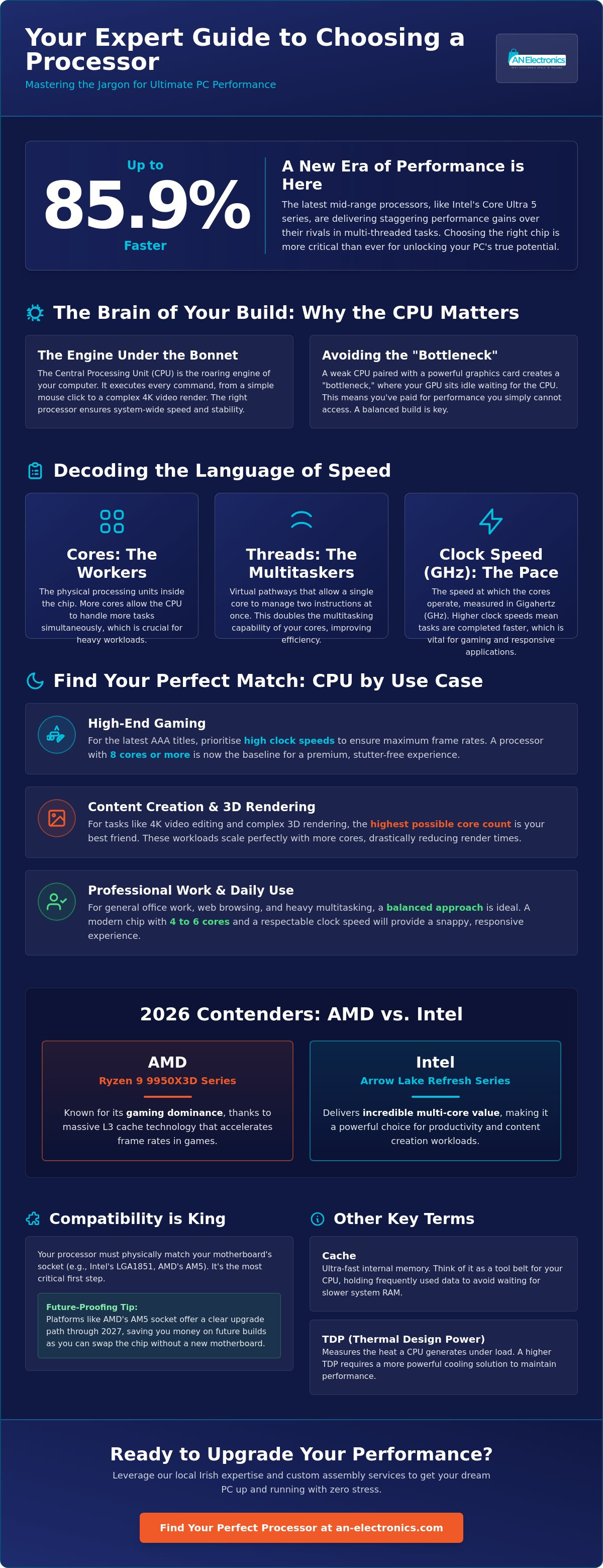
Think of your computer as a high-performance vehicle. If the graphics card is the sleek bodywork, the Central Processing Unit (CPU) is the roaring engine under the bonnet. This tiny piece of silicon executes every single command you give your system. Whether you're clicking a mouse or rendering a complex 4K video, the CPU handles the heavy lifting. Choosing the right processors for your build isn't just about raw speed; it's about system-wide stability.
Your processor dictates the rhythm of your digital life. It controls how fast your PC boots up and how quickly professional applications respond. It's the most critical component to get right during a custom build. If you pick a weak chip, you'll face the dreaded "bottleneck". This occurs when a powerful graphics card sits idle, waiting for a slow CPU to finish its logic calculations. You end up paying for performance you simply cannot access. Don't let a poor choice throttle your potential.
CPU vs GPU: Understanding the Difference
Whilst they both process data, they have very different roles. Your GPU is a specialist that handles complex visuals and textures. In contrast, the CPU manages the logic, physics, and background instructions of your software. For high-end gaming, you need a perfect balance between both. A fast CPU ensures high frame rates by feeding data to the GPU without a millisecond of delay. Many modern chips now include integrated graphics too. These are brilliant for basic tasks or as a reliable backup if your main graphics card ever needs a rest.
The Importance of Socket Compatibility
Compatibility is king. Processors must physically and electronically match the motherboard socket to function. It's like a key and a lock; if they don't match, nothing happens. Checking for socket types like AMD's AM5 or Intel's LGA1851 is the vital first step when comparing different processors. We always recommend looking for platforms with longevity. AMD's AM5 socket is a fantastic choice because it offers a clear upgrade path through 2027. Picking a long-lived socket saves you serious money on future upgrades. You can simply swap the chip without buying a whole new motherboard.
Deciphering the Specs: Cores, Threads, and Clock Speeds
Spec sheets for modern processors often look like a foreign language. Don't let the numbers intimidate you. They are simply the blueprints of your system's potential. To build a machine that actually performs, you need to look past the marketing fluff and understand the three pillars of CPU performance. It's about finding the right tool for your specific job.
Think of cores as the individual physical workers inside your chip. If you have an 8-core processor, you have eight distinct units tackling tasks. Threads are the virtual pathways that allow those workers to multitask. They enable a single core to manage two instructions simultaneously, much like a chef using both hands to prep different ingredients. Understanding the balance between Cores, Threads, and Clock Speeds is the secret to a snappy, responsive PC. Clock speed, measured in Gigahertz (GHz), acts as the tempo. It's the speed at which those workers operate. A higher GHz means your workers are moving faster, finishing individual tasks in less time.
You will often face a trade-off. Do you want many "slower" cores or fewer "fast" cores? For gamers, high clock speeds usually take priority because most game engines value quick individual instructions. However, if you're a professional designer, you'll want as many cores as possible to crush through heavy workloads. If you're unsure which path to take, browsing our latest computer components can give you a better idea of what's available for your budget.
When Do More Cores Actually Help?
Basic office work is relatively light. You rarely need more than 4 to 6 cores for spreadsheets, emails, or web browsing. However, 4K video editing and 3D rendering scale perfectly with high core counts. The more workers you have, the faster the render finishes. By 2026, most modern games are optimised for 8 cores or more. If you want to avoid stuttering in the latest AAA titles, an 8-core chip is now the baseline for a premium experience.
Understanding Cache and TDP
Cache is your CPU's ultra-fast internal memory. It stores frequently used data so the processor doesn't have to wait for the slower system RAM. Think of it as a tool belt; the larger the cache, the less time the worker spends walking back to the warehouse for supplies. TDP, or Thermal Design Power, is equally vital. It measures how much heat the chip generates under load. High-performance processors have higher TDPs, which dictates your choice of cooler. You'll need a beefy heatsink or liquid cooling to keep these chips from slowing down to protect themselves from heat damage.
AMD vs Intel in 2026: Finding Your Performance Match
The battle for dominance in the 2026 CPU market is a total shootout. For Irish builders, the choice between AMD and Intel has never been more competitive or more rewarding. Both giants have released hardware that pushes the limits of what processors can achieve. Whilst Intel focuses on raw multi-core power and hybrid efficiency, AMD continues to lead the pack in gaming performance and platform longevity. The "best" brand for your build often comes down to your specific workload and current market pricing.
Intel Core Ultra: The Hybrid Architecture Approach
Intel's Core Ultra 200 series, built on the Arrow Lake Refresh architecture, is a multitasking powerhouse. It utilises a sophisticated mix of Performance-cores (P-cores) and Efficient-cores (E-cores) to balance heavy lifting with background tasks. This makes Intel a firm favourite for high-frequency gaming and professional Adobe software. The performance gains are massive. For example, the Intel Core Ultra 7 270K Plus is over twice the speed of the AMD Ryzen 7 9700X in multi-threaded benchmarks. Additionally, these new processors feature dedicated AI-acceleration hardware, future-proofing your system for the next generation of intelligent software and creative tools.
AMD Ryzen: Efficiency and Multicore Dominance
AMD has secured its reputation for incredible performance-per-watt in 2026. Their Zen 5 architecture is remarkably efficient, running cooler than many Intel counterparts whilst delivering top-tier speed. The real star for gamers is the "X3D" technology. The Ryzen 7 9850X3D, with its massive 96MB L3 cache, remains the gold standard for competitive gaming. It provides a 4% performance bump over the previous 9800X3D, ensuring your frame rates stay buttery smooth in the most demanding titles. For those looking for long-term value, AMD’s AM5 platform is unbeatable. With confirmed support through 2027 and beyond, you can upgrade your CPU in a few years without needing a new motherboard.
Choosing between these titans requires a clear look at your priorities. Intel currently holds the crown for budget all-purpose performance; the Core Ultra 5 250K Plus is a colossal 85.9% quicker than the Ryzen 5 9600X in multi-threaded tasks. However, Intel's LGA1851 socket is considered a "dead-end" with no future upgrade path, whereas AMD offers a clear road ahead. You should check out PCMag's Best CPUs for 2026 to see how these models stack up in real-world testing. Ultimately, your decision should hinge on whether you value immediate multi-core value or the long-term flexibility of your motherboard platform.
Choosing by Use Case: Gaming, Work, or Content Creation?
Finding the perfect balance is the smartest way to save money on your build. Many people fall into the trap of buying massive, server-grade processors for a standard home PC. It's a total waste of cash. You don't need a 64-core monster just to play the latest titles or manage a spreadsheet. Instead, focus on finding the "sweet spot" that matches your daily habits. We always encourage our local customers to browse our full range of processors to see what's currently in stock before committing to a specific platform.
The Ultimate Gaming Setup
For most gamers in 2026, 6 to 8 cores are the gold standard. You want high boost clocks to ensure your frame rates stay high and stable during intense action. A common mistake is spending half your budget on a CPU and leaving nothing for the graphics card. Don't fall for it. A mid-range chip, like the Intel Core Ultra 5 250K Plus, paired with a top-tier GPU will almost always deliver a better experience than the inverse. Speed is also about synergy. Ensure you pair your new chip with fast DDR5 memory to eliminate data bottlenecks and keep your system feeling snappy.
Content Creation and Heavy Multitasking
Professional work requires more workers in the engine room. If you are editing 4K video, streaming on Twitch, or handling complex 3D renders, you need at least 12 cores. High thread counts are vital here; they prevent your system from stuttering or freezing whilst you wait for a heavy export to finish. It's about maintaining a smooth, uninterrupted workflow. A balanced system also needs a GPU that can keep up with your brain's pace. Check out our guide on choosing the right graphics card to find the perfect partner for your high-core-count chip.
Everyday Home and Office Use
You don't need to break the bank for a reliable home office machine. Budget-friendly 4-core options handle web browsing, emails, and spreadsheets with absolute ease. These chips stay remarkably cool and draw very little power. If you aren't gaming, look for processors with integrated graphics. This removes the need for a dedicated graphics card entirely, saving you hundreds of Euro. Even for a budget build, always aim for a modern architecture like AMD's Zen 5. It ensures your PC stays relevant, snappy, and secure for years to come.
Ready to upgrade your performance? Explore our latest computer components to find the perfect engine for your next build.
Upgrade Your Performance with AN Electronics
Selecting the right engine for your system is a massive win for your productivity and gaming. You now understand the difference between cores and threads. You know why socket compatibility is non-negotiable. Now, you need a reliable partner to bring that vision to life. Buying your processors from a 100% Irish retailer means you get more than just a box in the post. You get a community-oriented service that understands the local market and your specific needs. We're here to make sure your next upgrade is the best one yet.
Why Buy Locally from AN Electronics?
We aren't a faceless global corporation. We are your "trusted neighbour" in the tech world. Our expertise in the Irish market allows us to curate only the best high-end hardware for our customers. If you're stuck between two different chips, you can chat with us directly. We offer clear, jargon-free advice to ensure you don't overspend on features you'll never use. Plus, our national delivery is fast and reliable. You won't be waiting weeks for a package to clear international customs. Everything we stock is brand-new and ready to ship from our local warehouse. This means you can start your build sooner and with total peace of mind.
Bespoke PC Builds Tailored to You
Maybe you want the power of a 2026 workstation but don't want the stress of assembly. That's where our "Build Your Dream PC" service comes in. We take the guesswork out of the process entirely. Our experts handle the complex compatibility checks to ensure your chosen CPU and motherboard are a perfect match. We take care of the fiddly bits like precision cable management and optimal thermal paste application. Every system we build undergoes rigorous stress testing before it leaves our centre. This ensures your rig is stable and ready to perform from the moment you hit the power button. We love helping our customers reach their performance goals. Contact us today to discuss your specific requirements and let us build the system you've always wanted.
We are committed to supplying only the highest quality computer components to the Irish community. Whether you're a competitive gamer or a professional creator, we have the hardware to push your limits. Don't settle for "good enough" when you can have unbeatable performance. Our team is ready to help you navigate the latest processors and find the perfect fit for your budget.
Shop our latest processors and start your build today.
Ready to Power Up Your 2026 Build?
You now have the expertise to cut through the marketing noise and select the perfect engine for your system. Whether you're chasing the gaming crown or crushing heavy creative workloads, the right choice is within reach. Remember that the best hardware isn't just the fastest on a chart. It's the one that balances your specific needs with a clear path for future upgrades. We're here to ensure you get exactly what you need without any assembly stress.
As a 100% Irish Retailer, we take pride in being specialists in bespoke PC builds. Our expert technical support team is always ready to guide you through your component selection. Don't let an outdated system hold you back from your full potential. It's time to secure the hardware that will drive your success for years to come. Explore our full collection of high-performance processors and take the first step towards your dream rig today. We can't wait to see what you build!
Frequently Asked Questions
Which is better for gaming in 2026, Intel or AMD?
AMD currently holds the crown for raw gaming performance with its X3D series, thanks to the massive L3 cache that boosts frame rates in demanding titles. However, Intel remains a fierce competitor by offering excellent value and high clock speeds in their Core Ultra line-up. If you want the absolute fastest gaming chip, go for AMD. If you want a versatile, high-speed system that balances gaming with heavy productivity, Intel is often the better value choice.
Do I need a new motherboard if I upgrade my processor?
You will need a new motherboard if your current one uses an incompatible socket. For example, moving to the latest Intel Core Ultra processors requires the new LGA1851 socket, which isn't compatible with older boards. AMD users on the AM5 platform have more flexibility, as this socket supports multiple generations of chips. Always verify the socket type and chipset compatibility before you buy to ensure your new engine actually fits the bay.
What is the difference between Boxed and Tray processors?
Boxed processors come in official retail packaging and typically include a factory-certified cooler and a full manufacturer’s warranty. Tray versions are sold in simple protective clamshells without a cooler or fancy box. Whilst tray versions are sometimes slightly cheaper, we recommend boxed units for most home builders. This ensures you have the proper protective packaging and the peace of mind that comes with a standard retail warranty and a guaranteed cooling solution.
How many cores do I really need for video editing?
You should aim for at least 12 cores if you are regularly editing 4K video or working with complex 3D animations. High core counts allow your editing software to render multiple frames simultaneously, which slashes your export times. For lighter 1080p projects or hobbyist YouTube work, 8 cores are usually plenty. Having more threads ensures your system remains snappy and responsive even whilst your software is performing heavy background rendering tasks.
What happens if my CPU gets too hot?
Your CPU will automatically slow itself down to protect its internal circuits, a process known as thermal throttling. You'll notice a sudden, sharp drop in performance or stuttering in your games. If the temperature continues to rise to dangerous levels, the system will trigger an emergency shutdown to prevent permanent hardware damage. This is why pairing your processors with a high-quality cooler and ensuring your PC case has excellent airflow is absolutely vital for long-term health.
Is it worth buying an i9 or Ryzen 9 for a standard gaming build?
It is generally not worth the extra cost if your primary goal is just gaming. These top-tier chips are designed for professionals who need massive multi-core power for tasks like 3D modelling or heavy code compilation. For a standard gaming rig, an i7 or Ryzen 7 is the "sweet spot" that provides all the speed you need. You're better off saving that extra cash and investing it into a more powerful graphics card or a faster monitor.
Does the processor affect my internet speed?
Your processor doesn't change the actual speed of your broadband connection, but it does affect how quickly your PC handles web data. If your CPU is outdated, complex websites and browser-based applications will feel sluggish and slow to load. A modern, fast chip allows your browser to render pages and process scripts instantly. It ensures that your hardware isn't the bottleneck when you're trying to take full advantage of a high-speed fibre connection.
Can I install a processor myself at home?
You can definitely install a processor yourself, provided you are careful with the delicate pins on the motherboard or the chip itself. It's a simple matter of aligning the gold triangle and gently lowering the lever. However, if you're worried about static or physical damage, our "Build Your Dream PC" service is the perfect solution. We handle the delicate assembly, apply the thermal paste perfectly, and stress-test the entire system so you don't have to worry about a thing.